YumeChud97
Chud
considering its called "fan service" i assume more than half of anime watchers enjoy watching soft porn in anime that is about fighting and/or everyday lifeLike if there's a single person who does
Last edited:
Follow along with the video below to see how to install our site as a web app on your home screen.
Note: This feature may not be available in some browsers.
considering its called "fan service" i assume more than half of anime watchers enjoy watching soft porn in anime that is about fighting and/or everyday lifeLike if there's a single person who does


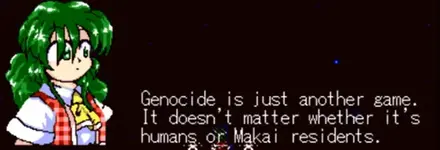
Didn't I just mention thatDo...people know that PC98 Alice is a nod to SMT Alice?
I honestly dont care, i still find her cute and better than windows era alice, wheter its a copy or not, the design is fire too, and i think she's the only character that isn't original so it's not that badDo...people know that PC98 Alice is a nod to SMT Alice?
Also Ellen, but who even remembers her?I honestly dont care, i still find her cute and better than windows era alice, wheter its a copy or not, the design is fire too, and i think she's the only character that isn't original so it's not that bad
How could i forget characters from the better touhou era?Also Ellen, but who even remembers her?
True true...How could i forget characters from the better touhou era?

It does ultimately seem like that is what happened in any case. I mainly started this thread to see other peoples' opinions on it and to try to find out if all this really was the cause of Alice's downfall in popularity, or if it was possibly something else.hm... well, things change. like u said she was popular around 2008-2010, which is probably because she was being featured in a significant amount of official works since she debuted in MS. and since she stopped appearing in games after soku, and was only a cameo in manga sometimes, i guess her popularity just started to sink as we got more characters that people would focus on.
This is wild, looks like i missed a lot skipping touhou 5 cuz of having more skill issue back then than now, but at the same time it's lowkey hilarious considering it's Touhou after allTrue true...
How dare you skipping mystic square man. Just how dare youThis is wild, looks like i missed a lot skipping touhou 5 cuz of having more skill issue back then than now, but at the same time it's lowkey hilarious considering it's Touhou after all
Sorry i just couldn't handle how much of their balls the girls were throwing at meHow dare you skipping mystic square man. Just how dare you

I suppose it just could be that ZUN started preferring some of the other characters he made, and eventually largely forgot about Alice for one reason or another. (Still hoping she comes back in an official game at some point though).ZUN fucking killed her in FDS and she was starting to get overshadowed by other characters

Aya and her damn journalism fanaticism!Alice was actually supposed to become a protagonist after IN, but Aya blackmailed her and stole all of her screen time because Aya wanted to be in five games back-to-back and appear in the majority of the manga. Alice has sadly never recovered from this.
Alice was actually supposed to become a protagonist after IN, but Aya blackmailed her and stole all of her screen time because Aya wanted to be in five games back-to-back and appear in the majority of the manga. Alice has sadly never recovered from this.


I think that much of what you said is very much true and is why Alice is becoming an increasingly interesting character for me.I think the thread has already identified part of the answer, but I disagree with the idea that Alice was popular mainly because there were fewer characters back then and because fans rewrote her into a Marisa-obsessed yuri girl.
That certainly describes one very visible part of old Alice fandom, but not the whole of it.
At her peak, Alice had something closer to an independent fan culture of her own. She could carry fangames, doujin stories, music videos and illustrations without Marisa necessarily being the central subject. Her appeal included her dolls, her workshop in the Forest of Magic, her position as a magician who was formerly human, the uncertainty surrounding her connection to Makai, the contrast between artificial beauty and something slightly unsettling, and her combination of social distance with occasional hospitality.
MariAli greatly amplified her visibility, but MariAli did not create all interest in Alice from nothing.
I also do not think calling her design “generic” explains very much. Blonde hair, blue eyes and a blue dress are certainly common components, especially for characters named Alice. But iconic character designs are rarely defined by isolated components. Alice together with her grimoire, Shanghai and Hourai dolls, seven-colored magic, European dollmaker imagery, forest workshop and possible Makai background is a much more distinctive package than “blonde girl in a blue dress.”
What I think actually declined was not Alice’s basic popularity, but the amount of new fan culture being actively produced around her.
Alice stopped receiving substantial new official material while Touhou continued introducing new characters, settings and relationships. Every new game gives creators fresh music, dialogue, mysteries, pairings and memes to work with. Alice, meanwhile, has largely been left with material established between PCB and Hisoutensoku.
That does not mean there is “nothing to say about her.” It means that the fandom has already spent more than a decade saying many of the most obvious things.
Her major fan interpretations gradually became standardized: the elegant dollmaker, the lonely magician, the tsundere rival, the obsessive MariAli character, the secretly caring neighbor, the Makai-related Alice, and so on. Once a set of interpretations becomes familiar enough, creators often move toward characters whose possibilities still feel unexplored. The problem is not that Alice lacks depth, but that her existing depth has not been replenished by new official appearances.
This is why I would separate character popularity from current creative momentum.
Alice has not really become obscure. The Japanese popularity polls still place her near the upper end of the cast, despite her absence from major game roles for well over a decade. What has changed is that she is no longer one of the default characters around whom a large portion of current Touhou fan production is organized.
From what I have observed in the community, the situation is similar. Alice remains extremely recognizable and still has a dedicated fanbase. Almost nobody would regard her as an obscure character. However, fewer newer creators automatically choose her as a protagonist or central character, and many younger fans encounter newer characters before developing much interest in her.
So I think the original observation is real, but I would phrase it differently:
Alice has declined as a center of active derivative culture, not as a generally popular character.
She used to be one of the characters who defined what Touhou fan culture was producing at that moment. Today, she is more like a legacy giant: widely recognized, historically influential and supported by a durable fanbase, but no longer constantly supplied with new material or placed at the center of the fandom’s newest creative trends.
In other words, the affection for Alice has survived better than the creative boom surrounding her.