不人气的大狸子
Tanuki
An Outlier, Not a Verdict
What happened to Koishi Komeiji's vote structure in the 21st and 22nd Touhou Project Popularity Polls?
What happened to Koishi Komeiji's vote structure in the 21st and 22nd Touhou Project Popularity Polls?
A data-driven look at the 2025 first-choice spike, the 2026 follow-up, and what the public data can - and cannot - tell us.
A note before we start
This is not an accusation of cheating.
I am using words such as outlier, structural break, spike, and reversion in a statistical sense. A voting pattern can be highly unusual without being fraudulent, and aggregate data cannot identify the person or mechanism that produced it.
The purpose of this article is narrower:
Something unusual happened to the structure of Koishi Komeiji's support in the 21st Touhou Project Popularity Poll. What exactly changed, how unusual was it, and what did the 22nd poll tell us one year later?
The public results are surprisingly good at answering the first two questions. They are much weaker at answering the third question - why.
1. The key distinction: "how many people voted for her" is not the same as "how strongly they ranked her"
The character division uses weighted preferences. In the 21st and 22nd polls, the scoring system is:
- 1st choice: 3 points
- 2nd choice: 2 points
- other selected characters: 1 point
That means a character's final score is not the same thing as the number of people who selected that character.
For this analysis I use four basic quantities:
- N = actual number of voters who selected the character
- F = number of voters who placed the character 1st
- Support rate = N / total character-division voters
- First-choice share = F / N
The last measure is especially useful. It answers a simple question:
Among everyone who selected this character, what percentage treated them as their No.1 choice?
This article is therefore not just asking whether Koishi gained popularity. It is asking what kind of support she gained.
2. The three-year picture
All figures below are clickable; click an image to open the full-resolution version.
Here is the simplest overview.
| Measure | 20th Poll (2024) | 21st Poll (2025) | 22nd Poll (2026) |
|---|---|---|---|
| Total character voters | 56,855 | 58,509 | 64,454 |
| Koishi supporters (N) | 12,939 | 14,815 | 16,297 |
| First-choice votes (F) | 3,334 | 5,133 | 5,162 |
| Non-first-choice supporters | 9,605 | 9,682 | 11,135 |
| Second-choice votes | - | 2,607 | 3,176 |
| Support rate | 22.76% | 25.32% | 25.28% |
| First-choice share | 25.77% | 34.65% | 31.67% |
Figure 1 - Koishi three-year support structure

At first glance, this is a story of a very popular character becoming even more popular. Koishi was already a long-term top character before 2025, and she had already won a previous edition of the poll.
But once first-choice and non-first-choice votes are separated, the 20th -> 21st transition looks very different from the 21st -> 22nd transition.
3. The strange part of the 21st poll was not simply that Koishi gained votes
Between the 20th and 21st polls, total character-division participation rose from 56,855 to 58,509, an increase of only 2.91%.
Koishi's actual number of supporters rose from 12,939 to 14,815:
+1,876 supporters (+14.50%).
That is strong growth, but not yet the most interesting part.
Now split the growth by preference level:
- First-choice: 3,334 -> 5,133 = +1,799 (+53.96%)
- Non-first-choice: 9,605 -> 9,682 = +77 (+0.80%)
In other words, across the two aggregate snapshots, almost the entire net increase in Koishi support appeared in the first-choice count, while non-first-choice support was almost flat.
A wording warning is important here. This does not mean that "96% of new Koishi voters put her first." We do not have voter-level panel data, so we cannot track the same individuals from one year to the next. Some voters entered, some left, and some may simply have changed their ranking.
The defensible claim is:
At the aggregate level, roughly 96% of the net increase in Koishi support between the 20th and 21st polls was reflected in the first-choice count.
That is the first reason the 21st-poll data deserve attention.
4. The same pattern appears in both raw counts and normalized rates
A natural objection is that Koishi is already one of the largest characters in the poll. Large characters can produce large absolute changes.
So I looked at the Top 100 in two different spaces.
4.1 Raw-count space
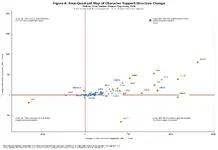
The horizontal axis below is the change in non-first-choice supporters. The vertical axis is the change in first-choice votes.
Koishi is approximately:
(+77, +1,799)
Figure 2 - 20th to 21st poll: raw-count support-structure scatter

The visual point is straightforward: Koishi barely moves horizontally but shoots upward far beyond the main cloud.
This is not what a simple, broad popularity increase usually looks like. A broad increase would normally push a character to the right as well as upward.
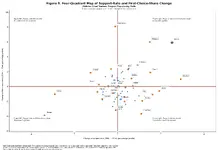
4.2 Normalized rate space
Now replace raw counts with:
- change in support rate
- change in first-choice share
Koishi becomes approximately:
- Support rate: +2.56 percentage points
- First-choice share: +8.88 percentage points
Figure 3 - 20th to 21st poll: normalized-rate scatter

The outlier does not disappear after expressing both dimensions as normalized rates.
That is important. The 2025 pattern was not merely "Koishi is big, therefore her raw numbers move a lot." The composition of her support changed unusually quickly.
5. The historical comparison is just as striking
I also compared annual changes in first-choice share across a fixed panel of long-running top characters.
Across 96 prior year-to-year changes in that reference panel, the largest earlier positive increase was about +3.98 percentage points.
Koishi in the 21st poll:
+8.88 percentage points.
That is more than twice the previous maximum in the predefined comparison set.
This does not mean there is a "98.97% probability" of wrongdoing. The empirical tail count is not a conventional p-value, and it certainly is not a probability of cheating.
The correct statement is much simpler:
Within this historical comparison set, no previous annual increase was as large as Koishi's 2025 jump.
6. Koishi had already been trending upward - which makes the question more specific, not less important
It would be misleading to pretend Koishi had been flat before 2025.
Her first-choice share from 2016 through 2024 was approximately:
22.94 -> 21.01 -> 22.26 -> 20.78 -> 21.87 -> 22.61 -> 23.16 -> 24.68 -> 25.77
So yes: there was already a late-period upward trend.
The question is not whether Koishi was rising. She clearly was.
The question is whether that trend explains a one-year jump to 34.65%.
Simple trend benchmarks also fail to account for the size of the jump. An OLS trend fitted to 2016-2024 predicts a 2025 first-choice share of about 24.95%, with a small-sample 95% prediction interval of approximately 21.51%-28.39%. Restricting the trend to 2020-2024 gives a prediction of about 26.58%, with a 95% prediction interval of approximately 25.13%-28.03%. A Theil-Sen robust trend estimate is also only about 25.45%.
These models should be treated as descriptive rather than as a literal data-generating process, but all of them place the observed 34.65% well above the continuation of the previous trend.
Figure 4 - Koishi first-choice share, 2016-2026
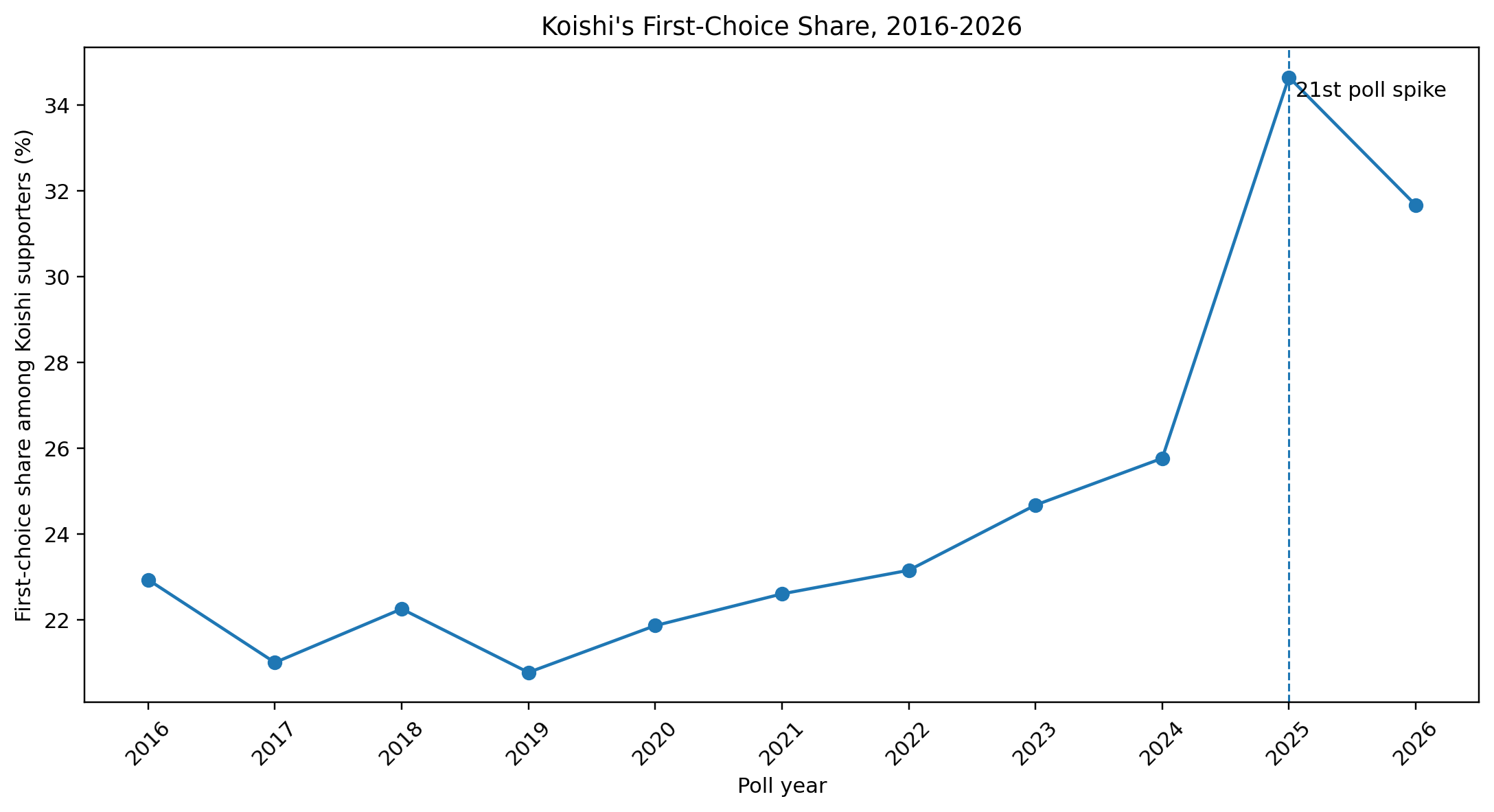
The fairest summary is therefore:
Koishi was already rising, but the 21st poll looks like an acceleration or structural break rather than a routine continuation of the earlier trend.
7. Why the 3-2-1 system matters - and why it does not explain the spike by itself
The 21st poll is also interesting because the final ranking was unusually sensitive to preference order.
In the same 21st-poll ballots:
- By raw number of supporters, Koishi was 3rd.
- Under a reconstruction similar to the older selection-plus-favorite scoring logic, Koishi was also 3rd.
- By first-choice votes, Koishi was 1st.
- Under the official 3-2-1 score, Koishi was 1st.
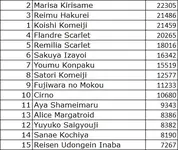
Her official score was 27,688, only 135 points ahead of Marisa.
This does not mean the new rules "created" the 34.65% first-choice share. A scoring rule cannot mechanically force voters to rank one particular character first.
What the rules did was different:
They amplified the electoral effect of an already unusually concentrated first-choice structure.
That distinction matters. The scoring system explains why the concentration mattered so much for the championship. It does not explain why the concentration appeared.
8. A plausible normal explanation: Koishi's supporters are younger and newer
There is real evidence for a demographic explanation.
In the 21st-poll questionnaire, Koishi supporters were notably younger than the full survey sample.
| Age group | Koishi supporters | Overall sample | Difference |
|---|---|---|---|
| 10-14 | 23.96% | 19.51% | +4.45 pp |
| 15-19 | 43.41% | 38.10% | +5.30 pp |
Koishi supporters were also more likely to say that this was their first Touhou popularity poll:
- Koishi supporters: 43.13%
- Overall questionnaire: 37.96%
- Difference: +5.17 pp
This is important evidence against simplistic narratives that treat Koishi's support as somehow detached from a real fandom base.
However, the questionnaire has a major identification problem.
We know the demographics of people who selected Koishi.
We do not know the demographics of the people who placed Koishi first.
Those are not the same conditional distribution.
So a younger/newer voter cohort is a plausible and important explanation, but the public questionnaire cannot tell us whether it specifically generated the +1,799 first-choice increase.
9. Comment data do not show a collapse in visible engagement
Another common intuition is that if a large number of votes were low-engagement or artificial, perhaps they would not be accompanied by comments.
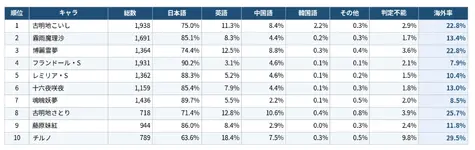
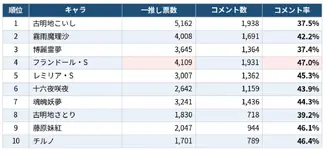
Koishi's comment counts were:
- 20th poll: 3,462
- 21st poll: 4,238
- 22nd poll: 4,612
The rough comment-to-support ratio did not collapse during the first-choice spike.
That weakens a very crude model in which a large mass of otherwise disengaged ballots simply appears without normal participation behavior.
But comments are only an auxiliary proxy. They cannot distinguish genuine fans from coordinated campaigning, strategic voters, manually operated multiple accounts, or other mechanisms.
So I treat comments as negative evidence against one simple model, not as proof of legitimacy.
10. Interpreting the ecosystem evidence more carefully
A simple reading of the 2025 results might suggest that Koishi's surge was disconnected from related characters, songs, and works. The detailed conditional results show that this interpretation is too strong.
Koishi voters are very strongly connected to the expected ecosystem.
Among Koishi supporters:
| Related choice | 21st poll | 22nd poll |
|---|---|---|
| Satori Komeiji | 33.24% | 35.91% |
| Flandre Scarlet | 39.66% | 44.43% |
| Hartmann's Youkai Girl | 53.02% | 54.14% |
| Last Remote | 13.96% | 14.99% |
| Subterranean Animism | 56.23% | 57.68% |
So the correct claim is not that Koishi voters stopped behaving like Koishi / Subterranean Animism fans.
The better description is:
The year-over-year growth rates were not synchronized.
Koishi's first-choice count jumped by 53.96% in 2025, while Satori, Hartmann, Last Remote, and Subterranean Animism did not experience a comparable same-year first-choice surge.
That is a much narrower claim, but also a much safer one.
11. Co-voting data suggest mainstreaming rather than a tighter closed bloc
Using the official co-voting tables compiled and discussed in reference [7], I recalculated standardized association measures including Lift and the phi coefficient.
Two of Koishi's strongest traditional relationships are especially interesting.
Koishi x Satori
- Lift: 2.30 -> 2.18
- phi: 0.299 -> 0.291
Koishi x Flandre
- Lift: 1.85 -> 1.68
- phi: 0.260 -> 0.219
The raw number of voters selecting both characters increased, yet the standardized relationship weakened.
This is not contradictory. Satori and Flandre themselves became more common choices across the whole electorate.
So Koishi voters remained highly likely to select them, but that behavior became less distinctive relative to the average voter.
The 22nd-poll conditional tables continue the same broad pattern: absolute co-voting remains strong, while the "specialness" of those links tends to decline.
That looks more like a support network becoming mainstream than a traditional small circle becoming increasingly closed and concentrated.
A technical note: the published co-voting table contains some pairwise inconsistencies where A-to-B and B-to-A common-voter counts are not identical. Because of these internal inconsistencies, exact pairwise metrics should be interpreted cautiously. Interval-based or sensitivity analyses are preferable to automatically choosing the larger of the two reported counts.
12. The 22nd poll gave us something much more valuable than another model: a new year of data
Before the 22nd results were released, I had already used the following heuristic interpretation bands in my working notes. These were not a formal public preregistration, so they should not be treated as one; I mention them only to make clear that the interpretation of the 22nd result was not chosen solely after seeing the outcome:
- 25-29%: strong reversion
- 29-32%: partial reversion
- 32-36%: high persistence
- above 36%: further strengthening
I also noted that if Koishi's total support continued to grow while first-choice share fell, that would be compatible with a mixture of long-term genuine popularity growth and a special 2025 first-choice concentration.
The 22nd poll produced:
31.67%.
That falls directly into the previously defined working-note partial reversion range.
This is why the 22nd poll is so useful. It is not another statistical model fitted to the same 2025 observation. It is a genuinely later observation that did not exist when the original anomaly was identified.
13. The 2026 growth pattern was almost the mirror image of 2025
This is probably the most intuitive result in the entire follow-up.
20th -> 21st
- Total Koishi support: +1,876
- First-choice: +1,799
- Non-first-choice: +77
21st -> 22nd
- Total Koishi support: +1,482
- First-choice: +29
- Non-first-choice: +1,453
Figure 5 - The mirror reversal: 2025 spike vs 2026 broadening
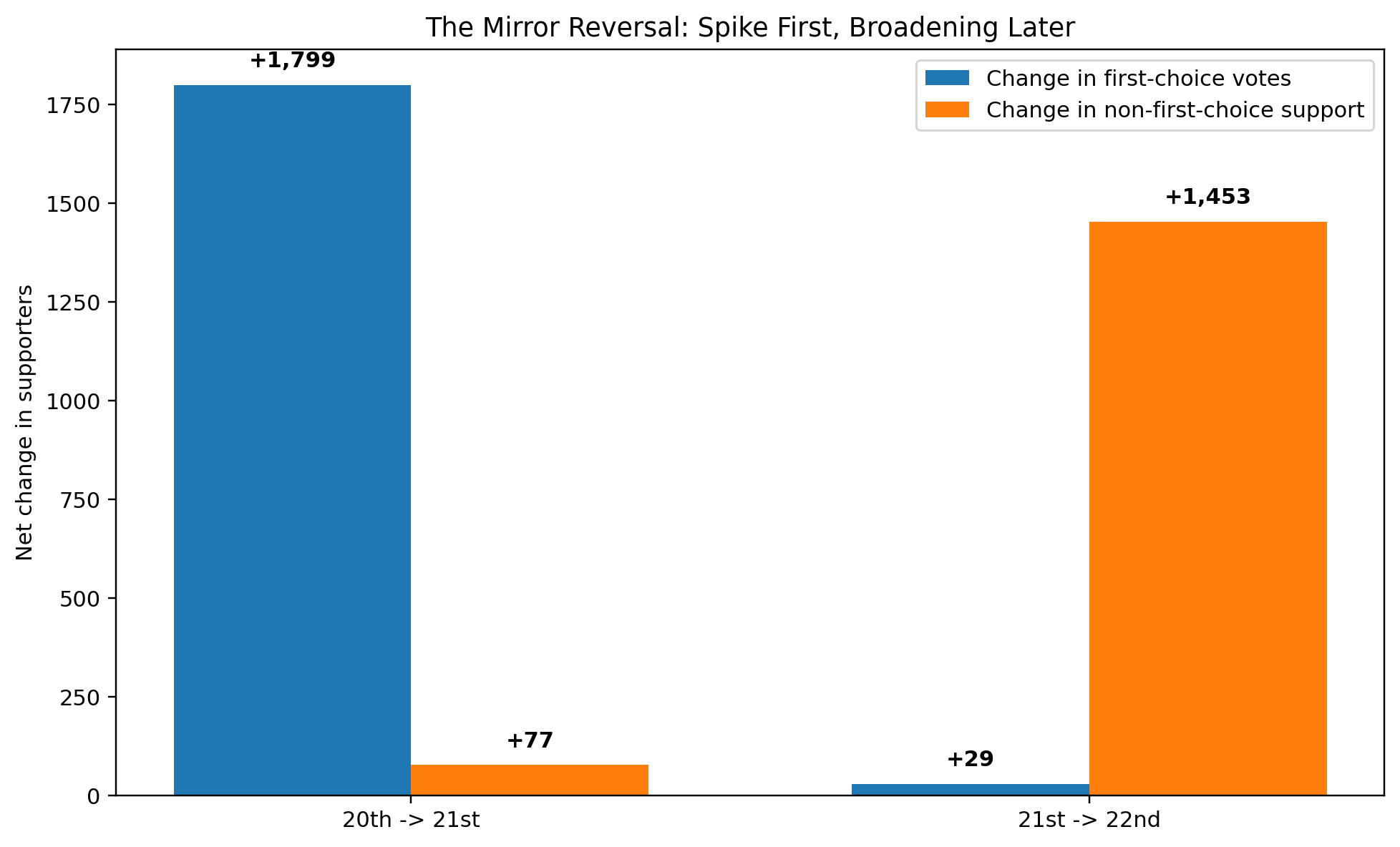
The two transitions are almost mirror images.
In 2025, support became sharply more top-heavy.
In 2026, first-choice support almost stopped growing, while broader support caught up.
I find "spiking -> broadening" a much more useful description than arguing immediately about whether the cause was legitimate or illegitimate.
14. The Top-100 distributions confirm that the 2025 pattern did not repeat
In raw-count space, Koishi's 21st -> 22nd position is approximately:
(+1,453 non-first-choice, +29 first-choice)
Figure 6 - 21st to 22nd poll: raw-count support-structure scatter

This is almost the geometric opposite of the previous year's vertical spike.
However, raw counts need one more correction. Total character turnout increased by 10.16% in the 22nd poll.
Koishi's supporter count increased by 10.00% - almost exactly in line with the whole division.
After normalization:
- Support rate: 25.32% -> 25.28% (about -0.04 pp)
- First-choice share: 34.65% -> 31.67% (-2.98 pp)
Figure 7 - 21st to 22nd poll: normalized-rate scatter

So the huge horizontal movement in raw supporter counts is mostly a turnout effect. Koishi did not gain additional market share in 2026.
The character-specific change that remains after normalization is actually a decline in first-choice concentration.
That is strong evidence against the idea that the 2025 first-choice spike was simply continuing to strengthen year after year.
15. But the 2025 change did not completely disappear either
If we compare only the endpoints - the 20th and 22nd polls - Koishi is still well above her 2024 baseline.
Two-year net change
- First-choice votes: +1,828
- Non-first-choice supporters: +1,530
- Support rate: +2.52 pp
- First-choice share: +5.90 pp
Figure 8 - 20th to 22nd poll: cumulative raw-count change

Figure 9 - 20th to 22nd poll: cumulative normalized-rate change

Figure 9 - 20th to 22nd poll: cumulative normalized-rate change
This creates an important three-stage picture:
Shock -> partial reversion -> persistence
or, more intuitively:
Spike -> broadening -> elevated new level
The 22nd poll did not erase the 21st-poll change. It partially reversed the concentration while broader support expanded.
There is also a methodological lesson here: if we looked only at the 20th and 22nd endpoints, Koishi's growth would look much more balanced. The intermediate 21st-poll observation reveals that the two components did not rise together. First-choice support surged first; broader support caught up one year later.
Endpoint comparisons can hide path dependence.
16. What does the 22nd poll do to the competing explanations?
The new data do not select one explanation, but they do change how convincing some stories are.
"Koishi's popularity itself is artificial"
This becomes much harder to defend.
Koishi has a broad and persistent supporter base, strong demographic patterns, strong connections to Satori / Flandre / Hartmann / Subterranean Animism, and large non-first-choice growth in the 22nd poll.
The 22nd poll provides strong evidence that Koishi has a very large and broad measured support base.
"34.65% was simply a permanent new first-choice regime"
This becomes weaker.
The first-choice share fell from 34.65% to 31.67% rather than remaining flat or strengthening.
"The 21st poll saw unusually strong legitimate campaigning"
Still entirely plausible.
A coordinated campaign telling existing fans to rank Koishi first could produce a sharp first-choice spike without an equally sharp immediate increase in broader support.
"There was a real sudden preference shift toward making Koishi the favorite"
Also plausible.
A fandom can experience a rapid favorite-conversion event before surrounding cultural indicators fully catch up.
"The 21st poll included prohibited duplicate or repeated-identity voting"
The public aggregate data cannot rule this out either.
But they also cannot identify it.
We do not have public voter-level identity, device, IP, time-series, ballot-template, or duplicate-account data. That is the central limitation.
17. A statistical anomaly is not the same thing as an officially confirmed improper-vote case
There is a useful historical control case.
In the 17th Touhou Project Popularity Poll, the organizing committee publicly stated that it had found several improper votes and that character rankings might change. The organizers subsequently continued the aggregation process, and the later detailed release contained revised totals and rankings. Contemporary archives preserve the official statement. [8][9]
That is a completely different evidence category.
17th poll
Official confirmation + later revised results21st poll
Strong aggregate statistical anomaly + no official confirmation of improper votingThe existence of the former does not prove the latter.
But it is useful because it shows what a genuinely confirmed improper-vote case looks like: an organizer statement and an observable correction, not simply an unusual scatter plot.
18. Four things that should not be collapsed into the word "cheating"
A lot of arguments about popularity polls become confused because several different behaviors are treated as if they were identical.
1. Ordinary campaigning
"Please vote for Koishi."Normal fandom behavior.
2. Incentivized campaigning
"Vote for this character and show a screenshot for a chance to win merchandise."Potentially controversial as a matter of community norms, but not automatically equivalent to duplicate voting.
3. Strategic ranking
"Put Koishi first because first place is worth three points."Potentially very important under the 3-2-1 system, but not automatically against the rules.
4. Duplicate / repeated-identity voting
One person violating identity or voting restrictions to generate multiple ballots.This is the category that requires actual audit evidence.
Treating all four as the same thing makes serious discussion almost impossible.
19. What the public data support - and what they do not
I think the public data support these statements quite strongly:
- Koishi's 2025 first-choice concentration was historically unusual.
- The 20th -> 21st change was unusual both in raw counts and after normalization.
- The shift was concentrated specifically in first-choice support rather than broad support.
- The 3-2-1 system made that concentration electorally important.
- The same first-choice explosion did not repeat in 2026.
- The 22nd poll instead showed partial mean reversion and broad non-first-choice growth.
- Koishi's measured support is broad, persistent, and embedded in a clearly observable fandom ecosystem.
- The 21st-poll spike therefore looks like a special event inside a real long-term popularity trend.
The public data do not establish:
- how many first-choice voters selected only one character,
- the average number of characters selected by Koishi-first voters,
- the joint distribution of first and second choices among Koishi-first voters,
- repeated ballot-template patterns,
- temporal clustering of ballots,
- device / IP / account duplication,
- or the identity of any voter.
Without those data, several causal mechanisms remain observationally compatible with the same aggregate pattern.
Conclusion: an outlier, not a verdict
The most interesting thing about Koishi Komeiji's 21st-poll victory is not simply that she won.
She was already one of Touhou's biggest characters, and the 22nd poll makes her genuine popularity even harder to dispute.
The unusual part is narrower and more specific.
Between the 20th and 21st polls, Koishi's support became suddenly and dramatically more concentrated in the first-choice position:
- first-choice votes: +1,799
- non-first-choice support: +77
- first-choice share: 25.77% -> 34.65%
That change was extreme relative to both her own previous trajectory and the contemporary Top-100 distribution.
One year later, however, the pattern did not repeat:
- first-choice votes: +29
- non-first-choice support: +1,453
- first-choice share: 34.65% -> 31.67%
The three-year sequence is therefore best described as:
A long-term popularity trend experienced an unusually sharp first-choice concentration shock in 2025, followed in 2026 by partial mean reversion, broader support, and persistence above the older baseline.
That is an empirical description.
Its cause is a separate question.
The pattern is compatible with several mechanisms: a real preference shift, unusually strong but legitimate campaigning, strategic use of the ranking system, or other voting behavior. Public aggregate data cannot distinguish among them.
So the strongest conclusion I am comfortable making is not an accusation.
It is a request for better auditability - and more precise language when discussing unusual voting data.
An anomaly can be demonstrated. Its cause cannot.
Methodology appendix
A. Data reconstruction
For the 20th poll, the older scoring system can be written as:
Score = N + F
so:
N = Score - F
For the 21st and 22nd polls, the 3-2-1 system gives:
Score = N + 2F + S
where S is the number of second-choice votes, so:
N = Score - 2F - S
Then:
Non-first-choice supporters = N - F
Support rate = N / total character voters
First-choice share = F / N
B. Cross-sectional outlier plots
For the 20th -> 21st comparison, the main comparable Top-100 sample contains 99 characters after excluding a new character that had no previous-year observation.
For the 21st -> 22nd comparison, the comparable sample contains 96 characters.
Two spaces are used:
1. Raw counts: change in non-first-choice supporters x change in first-choice votes.
2. Normalized rates: change in support rate x change in first-choice share.
The source analysis uses Tukey IQR fences (1.5 x IQR and 3 x IQR) as descriptive outlier screens. Crossing an IQR fence means that a value is unusual relative to the contemporary distribution. It does not produce a probability of cheating.
C. Historical comparison
A fixed panel of long-running top characters is used to compare annual first-choice-share changes before the 21st poll. The 96 prior changes are an empirical historical reference, not an iid statistical sample.
For that reason, z-scores, MAD-based scores and empirical tail counts are used as descriptive anomaly scales, not as literal causal probabilities.
D. Questionnaire limitations
The demographic questionnaire is voluntary. Non-response may be non-random (MNAR), and the questionnaire describes Koishi supporters in general, not specifically Koishi-first voters.
It should therefore be treated as supporter-profile evidence, not as a direct explanation of the first-choice spike.
E. Co-voting limitations
Published co-voting tables are aggregate, not full anonymous ballot records. They cannot tell us the complete ballot structure of Koishi-first voters.
Some published pairwise common-voter counts are also internally inconsistent in opposite directions (A->B vs B->A). Robust analysis should treat those discrepancies as intervals or run sensitivity checks instead of silently choosing one side.
F. What would actually resolve the causal question?
The most useful additional data would be anonymized audit summaries such as:
- distribution of ballot size among first-choice voters,
- first-choice x second-choice joint tables,
- single-selection ballot rates,
- repeated ballot-template frequency,
- coarse time clustering,
- number of ballots removed by anti-duplicate checks,
- and a public description of invalid-vote / duplicate-vote handling.
These would improve auditability without requiring the organizers to reveal personally identifying voter information.
Public references
[1] 20th Touhou Project Popularity Poll - official results
https://toho-vote.info/results/20
[2] 21st Touhou Project Popularity Poll - official results archive
https://toho-vote.info/results/21
[3] 22nd Touhou Project Popularity Poll - official result portal
https://toho-vote.info/result
[4] THBWiki - 20th poll, character division
https://thwiki.cc/东方系列人气投票/第二十回/角色部门
[5] THBWiki - 21st poll, character division
https://thwiki.cc/东方系列人气投票/第二十一回/角色部门
[6] Cross-check dataset for the 19th-21st polls (GitHub)
https://github.com/xiangze/toubou_vote_analysis/tree/main/data/19_21
[7] Chinese fan analysis of the 21st poll, including co-voting relationships
https://www.bilibili.com/opus/1241248116965900295
[8] Contemporary archive quoting the official @toho_vote notice of Oct. 5, 2021 that several improper votes had been found
https://danmakublog.com/archives/10929799.html
[9] Contemporary follow-up archive recording the later detailed / revised release for the 17th poll
https://danmakublog.com/archives/10939862.html