不人气的大狸子
Tanuki
Note: This article was written on August 21, 2026, the day the 22nd Touhou Project Popularity Poll began. Inevitably, some of the information here may become dated in the future, so I want to state that up front.
Today, let's talk about Mamizou Futatsuiwa. By now she is already something of a veteran character—at least if, like me, you use 2017 as a rough dividing line between the 'old' and 'new' generations. She first appeared as the Extra Stage boss of Ten Desires, in what is also one of the easier Extra Stages in the series. Mamizou has now been around for fifteen years. It is a reminder of just how long-lived Touhou is: it is surprisingly easy to forget that the series is already celebrating its 30th anniversary.
Of course, if you pay much attention to the popularity rankings, you probably already have a rough impression of Mamizou: a highly recognizable character with a stable core fanbase, but one who generally sits somewhere in the lower half of the middle tier. I realize that sounds almost meaningless, because once you get past the household-name characters who dominate fanworks, a very large part of Touhou's cast could be described the same way.
Still, since not everyone follows this closely, here is the short version. Mamizou debuted as the Extra Stage boss of Ten Desires. In her first Touhou Project Popularity Poll, she placed 60th, making her the second-lowest-ranked Ten Desires character, ahead only of Tojiko. After the heavy exposure she received from works such as Hopeless Masquerade and Forbidden Scrollery, she climbed as high as 48th—but that remains her all-time peak. Her rankings afterward were 61st, 64th, 68th, 75th, 79th, 81st, 78th, 75th, 73rd, and 78th, gradually settling around the 70s. In the 21st Popularity Poll, Mamizou placed 78th with 1,377 votes and 1,513 points, including 136 first-choice (ichioshi) votes.
Looking at those numbers alone, Mamizou seems like just one mid-tier character among Touhou's enormous cast. The problem is that ZUN very clearly does not use her like a character of that popularity level. And that is where the topic of this article begins.
Ever since her debut in Ten Desires in 2011, Mamizou has not faded into the background after her game the way many characters do. Instead, she was rapidly integrated into Touhou's continuing official narrative. She became playable in Hopeless Masquerade, Urban Legend in Limbo, Antinomy of Common Flowers, and Unfinished Dream of All Living Ghost, while also appearing in games such as Impossible Spell Card, Violet Detector, and 100th Black Market. In the official manga, she appeared in 31 of Forbidden Scrollery's 53 chapters and in 43 of the first 72 chapters of Lotus Eaters as of this writing, giving her approximate appearance rates of 58.5% and 59.7% respectively. She has also appeared in Wild and Horned Hermit, the Sangetsusei manga, Foul Detective Satori, and other official publications.
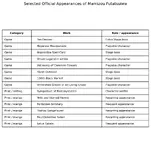
In other words, if you made one table for 'Popularity Poll ranking' and another for 'frequency of official use,' Mamizou would occupy a strikingly mismatched position. She is nowhere near popular enough for her ranking alone to explain the amount of official exposure she receives. That is the phenomenon I want to discuss: why does a character who has remained mid-tier in the Popularity Poll for years continue to have a level of presence in official works far above what her popularity ranking would seem to predict?
I wanted to make this article at least somewhat rigorous and research-like, so for the moment I am going to give this phenomenon a grand-sounding name. I have never received any formal training in this kind of analysis, but 'the Mamizou Paradox' will do.
The original reason I started writing this was a conversation with several fellow Mamizou fans. They had all heard a rumor that, sometime after 2011, ZUN had deliberately tried to push one particular character by increasing her appearances, only for that character's popularity to remain stubbornly low. They independently assumed that the character in question must have been Mamizou. I could not find the original quote from ZUN, but the rumor made me curious. After digging into the subject, I ended up with a rather practical conclusion: a character being 'extremely useful' to an author and a character being a fan's 'favorite' have never been the same system of evaluation.
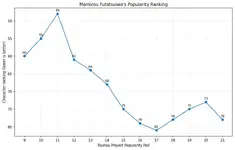
There is an interesting trend in the first few years after Mamizou entered the Popularity Poll: her ranking actually improved year by year. During that period, works such as Symposium of Post-mysticism, Forbidden Scrollery, and Hopeless Masquerade gradually filled out her characterization. That official exposure really did succeed in turning some people who merely 'knew Mamizou' into people who 'liked Mamizou,' and the improvement showed up in the rankings.
And then... that was it. Forbidden Scrollery did not stop serialization, and Mamizou did not disappear from the story. Urban Legend in Limbo gave her an important role. Antinomy of Common Flowers made her playable again. Wild and Horned Hermit paired her off against Kasen. Lotus Eaters once again turned her into a long-term recurring presence. Later, Unfinished Dream of All Living Ghost even made her a full playable character again.
Yet her popularity ranking never returned to anywhere near 48th. Instead, she slid through the 60s, the 70s, and eventually into the 80s. Once the audience already knew who she was, further exposure no longer expanded her fanbase in the same way. You can say of many characters that they 'never became popular because they barely appeared.' You cannot really say that about Mamizou. And yet, strangely enough, even after her popularity fell, ZUN did not reduce how often he used her.
At a ZUN lecture held during the University of Tokyo's Komaba Festival in 2010, an attendee took notes on the talk. When ZUN was asked whether derivative works could in turn influence the official series, the attendee recorded his answer roughly as follows: 'If there is enough of it, yes, I am influenced. If a character is popular, it makes me want to put her in; if she is unpopular, it makes me less inclined to put her in.'
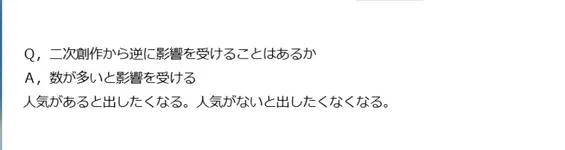
Well, that makes Mamizou rather awkward in the context of this quote. Then again, ZUN has contradicted himself often enough. Flandre, for example, consistently ranked very well in the popularity polls, yet she did not make a major return in an official game until Sunken Fossil World. ZUN's contrarian streak is pretty obvious. In Mamizou's case, the cycle can be summarized like this:
By the 21st Popularity Poll, Mamizou was still only 78th—basically clinging to the top 80. And yet Lotus Eaters continued to have her participate in new incidents on a regular basis, even bringing her into storylines connected to Fossilized Wonders.
So rather than saying, 'ZUN kept pushing Mamizou and still failed to make her popular,' I think we should ask a more basic question first: once Mamizou had already shown that more exposure was not going to raise her popularity dramatically, why did ZUN continue choosing her again and again?
My answer is that Mamizou's 'utility to the author' is probably strong enough to offset her 'lack of fan popularity.' Put more plainly: Mamizou may not be very popular, but ZUN thinks she is extremely useful.
Yes, that entire wall of text above was only the introduction. Please forgive me; I am apparently incapable of extracting only the important points, so I have to say everything. But after all of that, we can at least arrive at one conclusion: the reason Mamizou appears so frequently in official works is that she is a 'narrative hub character.'
If I am going to invent a term, I should explain it. What exactly is a 'narrative hub character'? For a moment, we have to try looking at things from ZUN's point of view. (Me? Thinking like ZUN?) ZUN retains overall control and final interpretive authority over the plots of the official manga. So whenever he wants to write a story about the Human Village—or more generally, whenever he needs a plot-mover who belongs to no fixed faction, can plausibly show up almost anywhere, and can even serve as the person who ultimately brings a story to its conclusion—Mamizou's character design is almost absurdly luxurious. She feels as though she were born for the job.
Mamizou came from the Outside World and now lives in Gensokyo, so she understands what the Outside World is like while also being able to involve herself naturally in Gensokyo's internal affairs. She is a youkai, which lets her move within youkai society, while her transformation ability also lets her walk openly into the Human Village. She is the boss of the tanuki, with subordinates and an information network of her own, so she can proactively get involved in an incident without the story needing to invent a special motivation for her first.
That description alone is not enough, so let us look at some comparison cases—especially characters outside the protagonist group who also seem mysterious and who like getting involved in events. Yukari Yakumo is the most obvious example.
In many respects, Yukari's qualifications are even better than Mamizou's. The problem is her role: as one of Gensokyo's sages, she simply cannot appear too often without changing the meaning of a scene. Put differently, Yukari carries far too much narrative weight. Canon also says that she sleeps twelve hours a day and is active mainly from evening until late at night. (Although I suspect the image most people remember best of Yukari in the official manga is still from Silent Sinner in Blue.)
The moment Yukari starts participating in a story, readers immediately begin asking: is this connected to some hidden mastermind? Is this about something fundamental to Gensokyo? Does Yukari already know the whole truth? Is she manipulating things behind the scenes? A chapter that might otherwise be nothing more than an everyday Human Village episode can suddenly become overinterpreted simply because Yukari is there.
That is why I think ZUN understands very well where Yukari belongs in a story. In volume 3 of the Sangetsusei manga, for example, she can appear in the final chapter as a summarizing presence—or ZUN can use her voice to express his own ideas about science and religion. Yukari is a character who works best at very specific points in the narrative.
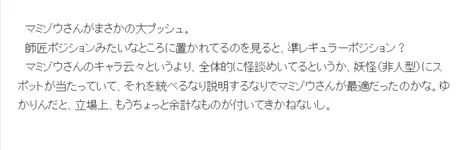
After the first volume of Forbidden Scrollery was published in 2013, at least one Japanese reader had already noticed Mamizou's unusual treatment and speculated that she might become a quasi-regular character. More interestingly, the explanation that reader gave at the time is already very close to my own conclusion here: Forbidden Scrollery needed someone who could manage or explain youkai affairs, and Mamizou might have been the most suitable choice. If Yukari were used instead, Yukari's own position would bring too much additional baggage with it.
So yes: if you want to understand ZUN's little habits, keep studying them!
In the bonus interview included with Symposium of Post-mysticism, ZUN explicitly discussed a character's 'usability' while talking about Tenshi Hinanawi. His point was that characters with straightforward personalities—characters who do not twist themselves into knots over everything—are easier to put into a fighting game, whereas timid or excessively hesitant characters are harder to arrange as participants.
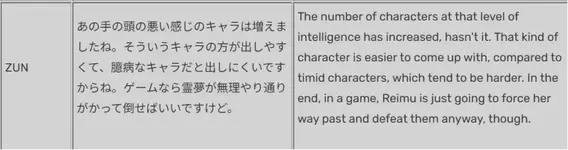
Even more directly, in the same interview he said of Kasen Ibaraki that 'she is also a very convenient character to use.' When discussing Momiji Inubashiri, he likewise called her 'a very convenient character' because white wolf tengu have many companions and possess clairvoyant abilities. These comments reveal an important part of ZUN's character-design logic: characters do not merely have 'settings' and personalities; they also have a degree of 'narrative usability.'
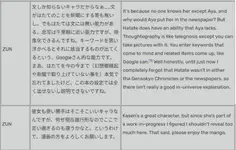
If we isolate Mamizou and look at her through that lens, we find that she is a highly proactive character. Forbidden Scrollery and Lotus Eaters show that she likes poking her nose into things and joining the fun. Even when an event has nothing to do with her personally, she can use the tanuki information network to learn what is going on. That means ZUN does not need a particularly strong external excuse to insert Mamizou into a plot, and doing so does not violate her established personality. That is extremely strong narrative initiative.
Someone might say that Aya Shameimaru seems like another excellent candidate by the same standard, and indeed Aya appears quite often in the official manga as well. But compared with Aya, Mamizou has more freedom of action. She has prestige, subordinates, a certain status within youkai society, and enough strength to keep ordinary youkai in check. At the same time, she is not a top-level authority like one of Gensokyo's sages: she cannot solve an incident with a single sentence, and she can even get scammed at Sannyo's gambling den. For a long-running story, that level of power and status is very comfortable for ZUN to work with.
I am dissatisfied enough with ZUN's writing in Foul Detective Satori that when Mamizou first appeared there I briefly felt a little PTSD. But before that, back in the Wild and Horned Hermit era, ZUN had already let Mamizou take a rather spectacular L. The TL;DR is that Mamizou challenged Kasen to a drinking contest, could not beat her honestly, tried cheating, failed at that too, and ended up embarrassing herself.
ZUN himself then said that he liked handling characters this way. Mamizou had entered looking powerful and had genuinely shown off some clever methods; at the time, she was also doing especially well in Forbidden Scrollery. ZUN said he enjoys taking a character who is active and impressive in one work and having that same character get taken down a peg in another.

That does create the impression that 'Mamizou's dignity can be built up or demolished whenever the story wants.' In another franchise, people might call that character assassination. With ZUN, however, it is completely normal. And in a way it also demonstrates how durable Mamizou is as a character: losing once does not destroy her appeal. In fact, getting embarrassed from time to time is already part of her charm.
Now we can finally talk about why Mamizou's 'usefulness' has never translated into high popularity. This is a question I have thought about for years as a Mamizou fan. Stripping away all the fancy terminology, I think the answer is that even though Mamizou appears frequently in official works, she is still usually supporting someone else's story. She may often stand near the center of the story's structure, but she rarely becomes its emotional center for the reader.
In Forbidden Scrollery, she spends a great deal of time around Kosuzu and has more page time than almost anyone outside the protagonist group—but Forbidden Scrollery is fundamentally about Kosuzu's experiences and growth. In Hopeless Masquerade, Mamizou has her own story route, but the character who actually undergoes a crisis of identity is Kokoro. In Lotus Eaters, we are used to Mamizou appearing in the background of almost every chapter, but the character the manga truly revolves around is Miyoi Okunoda.
In short, Mamizou is often the person who discovers a problem, explains it, points someone else toward it, or helps solve it. What she rarely gets is a story that is genuinely her own. In other words, appearing often does not necessarily mean that the character herself is being explored deeply. That sounds counterintuitive at first, but it is a real distinction.
Touhou is a community whose creative ecosystem is dominated by fanworks, and that has produced an enormous number of excellent derivative creations. But it is also obvious that the older characters from the EoSD/PCB/IN era still occupy a huge share of the fanwork landscape. I am not trying to complain about that. I simply think Mamizou is a character with a great many blank spaces left in her characterization, yet there is surprisingly little rich fanwork dedicated to filling them in. Even in many doujin works, Mamizou remains a supporting character.
Of course, the highly popular characters did not become popular only because they are old. This may annoy some character fans, but Mamizou's design and personality read as mature almost immediately. She is less likely than some characters to trigger reactions like 'holy crap, she is literally me,' 'I want to save and protect this character,' or 'this outfit is exactly my type.' If I had to summarize Mamizou with a handful of terms, I would choose: worldly, composed, seasoned, socially experienced, and someone who keeps a certain distance between herself and other people.
In the 21st Popularity Poll, among respondents who voted for Mamizou, the share of voters aged 15–19 was 8.86 percentage points lower than the overall respondent share. By contrast, ages 25–29 were 3.93 points higher, ages 30–34 were 2.66 points higher, and ages 35–39 were 1.50 points higher.
I then randomly checked the same kind of data from the 14th and 16th polls:
14th Poll: the 15–19 age group was 7.85 percentage points below the overall share; ages 25–29 were 3.28 points higher, ages 30–34 were 4.85 points higher, and ages 35–39 were 1.78 points higher.
16th Poll: the 15–19 age group was 7.54 percentage points below the overall share; ages 25–29 were 3.13 points higher, ages 30–34 were 4.30 points higher, and ages 35–39 were 2.01 points higher.

The pattern is fairly obvious. Of course, this does not prove that 'people start liking Mamizou as they get older.' The survey has its own selection effects, and age is only a correlated variable; we cannot establish direct causation from this. But it does show at least one thing: compared with the overall sample, Mamizou's supporter base is clearly tilted toward older age groups. That fits her character coding remarkably well.
Or, to use a term that most Touhou fans will probably understand: BBA enjoyers. A character like this can have a very stable, even extremely loyal core fanbase, while still being naturally less likely to receive a sudden mass surge of support from younger audiences.
Mamizou's biggest problem at the moment is that her high frequency of official appearances has made a great many Touhou fans remember her, but comparatively few people are willing to spend one of their Popularity Poll choices on her. They may think something Mamizou did in Forbidden Scrollery was cool, or notice that she became playable again in Unfinished Dream of All Living Ghost—but that is often where it stops. In the 21st Popularity Poll, Mamizou had 1,377 supporters, but only 136 first-choice votes, about 9.9%. That number cannot be interpreted in isolation without comparing it with other characters in the same poll, but it does point toward a useful direction for further study: Mamizou's core problem may not be awareness—her name recognition is actually quite good—but rather converting general goodwill into direct support.
A few days ago I saw an interesting thread on the Chinese Touhou Baidu Tieba asking what ships Sumireko Usami has. That indirectly illustrates another problem. Mamizou has a huge relationship network: Nue, Kosuzu, Kokoro, Reimu, Mokou, Aya, Kasen, Sumireko, Miyoi... she can be paired with almost anyone. But that is exactly the problem. She can be paired with almost anyone, yet no single relationship has become overwhelmingly dominant within the fanwork ecosystem around her.
All right, saying this will probably get me accused of lacking 'doujin spirit.' Obviously people are free to ship whatever they want; I am only analyzing the pattern here, not looking down on any particular pairing. The 13th Popularity Poll once included a pair category. Mamizou's highest-ranked pairing was Nue Houjuu × Mamizou Futatsuiwa, at only 63rd. Mamizou Futatsuiwa × Kosuzu Motoori placed 88th; Ran Yakumo × Mamizou Futatsuiwa placed 170th; Mamizou Futatsuiwa × Hata no Kokoro placed 245th; and Mamizou Futatsuiwa × Kasen Ibaraki placed 271st.
This contrasts sharply with some of Touhou's stronger character relationships. A popular pairing can continuously generate fanworks, memes, music, manga, shipping discussion, and new emotional interpretations for both characters. Mamizou's relationships are instead highly dispersed. For the official author, that is an enormous advantage: it means she can interact with almost anyone. For the derivative-work ecosystem, however, it is not necessarily an advantage, because no single relationship has enough gravitational pull to keep large numbers of creators focused on her for years at a time.
Once again, this shows the separation between authorial utility and fan emotional value. It may also reflect the way Touhou's storytelling changed after 2011. As the number of official works increased, the narrative focus gradually expanded from incident-resolution stories centered on the mainline games toward ongoing depictions of Gensokyo's everyday social structure. Characters in the early games could remain fixed in place as 'the boss who lives at location X.' But as the world grew larger, ZUN increasingly needed characters who could move naturally throughout Gensokyo—and Mamizou became one of those characters. From there, a kind of path dependence could develop: 'Oh, I need someone for a story about X... I may as well use Mamizou again.'
That is why I have mixed feelings when I return to the rumor that 'Mamizou was a character ZUN tried hard to push.' ZUN may not have kept using her because her popularity was too low and he wanted to invest more resources into raising it. He may have kept using her because she was already an exceptionally convenient character for moving stories forward. I can even offer one deliberately provocative take: maybe ZUN never needed Mamizou to become popular in the first place.
The reason we feel that a 'Mamizou Paradox' exists may be that we unconsciously assume the purpose of official appearances is to increase a character's popularity. But ZUN does not necessarily use characters according to the logic of a commercial franchise. In a huge, continuous fictional world, a character's value also includes whether that character makes the world easier to keep writing. In that sense, Mamizou Futatsuiwa may actually be one of the most successful utility-oriented characters ZUN has created since 2011.
So, very roughly, we can divide the value of a Touhou character into two dimensions.
The first is:
Narrative Utility to the Author
This includes the ability to enter different scenes naturally, initiative, information-gathering ability, social networks, organizational capacity, ability to move the plot forward, whether the character's power level is manageable, and flexibility in being paired with other characters.
The second is:
Emotional Value to Fans
This includes visual appeal, emotional projection, tragedy, moe traits, the desire to protect the character, character relationships, fanwork potential, the emotional force of the character's personal story, and the ability to become someone's number-one favorite.
Many characters score highly on both dimensions. Reimu and Marisa are the obvious examples: they are extraordinarily useful to the author and extraordinarily popular with fans. But there are also characters with very high emotional value to fans who are not easy to use frequently in official stories. I probably do not even need to list names here; every character fan reading this has likely already placed their own favorite somewhere on these axes. Mamizou, however, occupies a particularly interesting position.
After saying all of this, I hope I have not made other Mamizou fans depressed, as though Mamizou were nothing more than a tool ZUN can summon and dismiss at will. The reason ZUN likes putting Mamizou into stories so much is precisely that she is exceptionally well suited to the more social, society-focused style of Touhou storytelling that developed from the 2010s onward. In its own way, that is also a form of affection.
So Mamizou's situation—'appearing constantly in official works without ever becoming especially popular'—should probably not be understood simply as a failed attempt at character promotion. It is better seen as a highly representative case within Touhou's character ecosystem: the official narrative utility of a character and that character's emotional value to fans do not necessarily have a positive correlation.
Mamizou has ended up with a kind of character fate that is unusually rare in Touhou: she is not the brightest star, but she is always there when the story needs her. Perhaps that is what is truly special about Mamizou Futatsuiwa.
And in any case, maybe that is one of the reasons I like Mamizou. I expect I will keep liking her for a long time to come.
Today, let's talk about Mamizou Futatsuiwa. By now she is already something of a veteran character—at least if, like me, you use 2017 as a rough dividing line between the 'old' and 'new' generations. She first appeared as the Extra Stage boss of Ten Desires, in what is also one of the easier Extra Stages in the series. Mamizou has now been around for fifteen years. It is a reminder of just how long-lived Touhou is: it is surprisingly easy to forget that the series is already celebrating its 30th anniversary.
Of course, if you pay much attention to the popularity rankings, you probably already have a rough impression of Mamizou: a highly recognizable character with a stable core fanbase, but one who generally sits somewhere in the lower half of the middle tier. I realize that sounds almost meaningless, because once you get past the household-name characters who dominate fanworks, a very large part of Touhou's cast could be described the same way.
Still, since not everyone follows this closely, here is the short version. Mamizou debuted as the Extra Stage boss of Ten Desires. In her first Touhou Project Popularity Poll, she placed 60th, making her the second-lowest-ranked Ten Desires character, ahead only of Tojiko. After the heavy exposure she received from works such as Hopeless Masquerade and Forbidden Scrollery, she climbed as high as 48th—but that remains her all-time peak. Her rankings afterward were 61st, 64th, 68th, 75th, 79th, 81st, 78th, 75th, 73rd, and 78th, gradually settling around the 70s. In the 21st Popularity Poll, Mamizou placed 78th with 1,377 votes and 1,513 points, including 136 first-choice (ichioshi) votes.
Looking at those numbers alone, Mamizou seems like just one mid-tier character among Touhou's enormous cast. The problem is that ZUN very clearly does not use her like a character of that popularity level. And that is where the topic of this article begins.
Ever since her debut in Ten Desires in 2011, Mamizou has not faded into the background after her game the way many characters do. Instead, she was rapidly integrated into Touhou's continuing official narrative. She became playable in Hopeless Masquerade, Urban Legend in Limbo, Antinomy of Common Flowers, and Unfinished Dream of All Living Ghost, while also appearing in games such as Impossible Spell Card, Violet Detector, and 100th Black Market. In the official manga, she appeared in 31 of Forbidden Scrollery's 53 chapters and in 43 of the first 72 chapters of Lotus Eaters as of this writing, giving her approximate appearance rates of 58.5% and 59.7% respectively. She has also appeared in Wild and Horned Hermit, the Sangetsusei manga, Foul Detective Satori, and other official publications.
In other words, if you made one table for 'Popularity Poll ranking' and another for 'frequency of official use,' Mamizou would occupy a strikingly mismatched position. She is nowhere near popular enough for her ranking alone to explain the amount of official exposure she receives. That is the phenomenon I want to discuss: why does a character who has remained mid-tier in the Popularity Poll for years continue to have a level of presence in official works far above what her popularity ranking would seem to predict?
I wanted to make this article at least somewhat rigorous and research-like, so for the moment I am going to give this phenomenon a grand-sounding name. I have never received any formal training in this kind of analysis, but 'the Mamizou Paradox' will do.
The original reason I started writing this was a conversation with several fellow Mamizou fans. They had all heard a rumor that, sometime after 2011, ZUN had deliberately tried to push one particular character by increasing her appearances, only for that character's popularity to remain stubbornly low. They independently assumed that the character in question must have been Mamizou. I could not find the original quote from ZUN, but the rumor made me curious. After digging into the subject, I ended up with a rather practical conclusion: a character being 'extremely useful' to an author and a character being a fan's 'favorite' have never been the same system of evaluation.
There is an interesting trend in the first few years after Mamizou entered the Popularity Poll: her ranking actually improved year by year. During that period, works such as Symposium of Post-mysticism, Forbidden Scrollery, and Hopeless Masquerade gradually filled out her characterization. That official exposure really did succeed in turning some people who merely 'knew Mamizou' into people who 'liked Mamizou,' and the improvement showed up in the rankings.
And then... that was it. Forbidden Scrollery did not stop serialization, and Mamizou did not disappear from the story. Urban Legend in Limbo gave her an important role. Antinomy of Common Flowers made her playable again. Wild and Horned Hermit paired her off against Kasen. Lotus Eaters once again turned her into a long-term recurring presence. Later, Unfinished Dream of All Living Ghost even made her a full playable character again.
Yet her popularity ranking never returned to anywhere near 48th. Instead, she slid through the 60s, the 70s, and eventually into the 80s. Once the audience already knew who she was, further exposure no longer expanded her fanbase in the same way. You can say of many characters that they 'never became popular because they barely appeared.' You cannot really say that about Mamizou. And yet, strangely enough, even after her popularity fell, ZUN did not reduce how often he used her.
At a ZUN lecture held during the University of Tokyo's Komaba Festival in 2010, an attendee took notes on the talk. When ZUN was asked whether derivative works could in turn influence the official series, the attendee recorded his answer roughly as follows: 'If there is enough of it, yes, I am influenced. If a character is popular, it makes me want to put her in; if she is unpopular, it makes me less inclined to put her in.'
Well, that makes Mamizou rather awkward in the context of this quote. Then again, ZUN has contradicted himself often enough. Flandre, for example, consistently ranked very well in the popularity polls, yet she did not make a major return in an official game until Sunken Fossil World. ZUN's contrarian streak is pretty obvious. In Mamizou's case, the cycle can be summarized like this:
Mid-tier popularity → ZUN keeps using her → more exposure → still mid-tier popularity → ZUN keeps using her.
By the 21st Popularity Poll, Mamizou was still only 78th—basically clinging to the top 80. And yet Lotus Eaters continued to have her participate in new incidents on a regular basis, even bringing her into storylines connected to Fossilized Wonders.
So rather than saying, 'ZUN kept pushing Mamizou and still failed to make her popular,' I think we should ask a more basic question first: once Mamizou had already shown that more exposure was not going to raise her popularity dramatically, why did ZUN continue choosing her again and again?
My answer is that Mamizou's 'utility to the author' is probably strong enough to offset her 'lack of fan popularity.' Put more plainly: Mamizou may not be very popular, but ZUN thinks she is extremely useful.
Yes, that entire wall of text above was only the introduction. Please forgive me; I am apparently incapable of extracting only the important points, so I have to say everything. But after all of that, we can at least arrive at one conclusion: the reason Mamizou appears so frequently in official works is that she is a 'narrative hub character.'
If I am going to invent a term, I should explain it. What exactly is a 'narrative hub character'? For a moment, we have to try looking at things from ZUN's point of view. (Me? Thinking like ZUN?) ZUN retains overall control and final interpretive authority over the plots of the official manga. So whenever he wants to write a story about the Human Village—or more generally, whenever he needs a plot-mover who belongs to no fixed faction, can plausibly show up almost anywhere, and can even serve as the person who ultimately brings a story to its conclusion—Mamizou's character design is almost absurdly luxurious. She feels as though she were born for the job.
Mamizou came from the Outside World and now lives in Gensokyo, so she understands what the Outside World is like while also being able to involve herself naturally in Gensokyo's internal affairs. She is a youkai, which lets her move within youkai society, while her transformation ability also lets her walk openly into the Human Village. She is the boss of the tanuki, with subordinates and an information network of her own, so she can proactively get involved in an incident without the story needing to invent a special motivation for her first.
That description alone is not enough, so let us look at some comparison cases—especially characters outside the protagonist group who also seem mysterious and who like getting involved in events. Yukari Yakumo is the most obvious example.
In many respects, Yukari's qualifications are even better than Mamizou's. The problem is her role: as one of Gensokyo's sages, she simply cannot appear too often without changing the meaning of a scene. Put differently, Yukari carries far too much narrative weight. Canon also says that she sleeps twelve hours a day and is active mainly from evening until late at night. (Although I suspect the image most people remember best of Yukari in the official manga is still from Silent Sinner in Blue.)
The moment Yukari starts participating in a story, readers immediately begin asking: is this connected to some hidden mastermind? Is this about something fundamental to Gensokyo? Does Yukari already know the whole truth? Is she manipulating things behind the scenes? A chapter that might otherwise be nothing more than an everyday Human Village episode can suddenly become overinterpreted simply because Yukari is there.
That is why I think ZUN understands very well where Yukari belongs in a story. In volume 3 of the Sangetsusei manga, for example, she can appear in the final chapter as a summarizing presence—or ZUN can use her voice to express his own ideas about science and religion. Yukari is a character who works best at very specific points in the narrative.
After the first volume of Forbidden Scrollery was published in 2013, at least one Japanese reader had already noticed Mamizou's unusual treatment and speculated that she might become a quasi-regular character. More interestingly, the explanation that reader gave at the time is already very close to my own conclusion here: Forbidden Scrollery needed someone who could manage or explain youkai affairs, and Mamizou might have been the most suitable choice. If Yukari were used instead, Yukari's own position would bring too much additional baggage with it.
So yes: if you want to understand ZUN's little habits, keep studying them!
In the bonus interview included with Symposium of Post-mysticism, ZUN explicitly discussed a character's 'usability' while talking about Tenshi Hinanawi. His point was that characters with straightforward personalities—characters who do not twist themselves into knots over everything—are easier to put into a fighting game, whereas timid or excessively hesitant characters are harder to arrange as participants.
Even more directly, in the same interview he said of Kasen Ibaraki that 'she is also a very convenient character to use.' When discussing Momiji Inubashiri, he likewise called her 'a very convenient character' because white wolf tengu have many companions and possess clairvoyant abilities. These comments reveal an important part of ZUN's character-design logic: characters do not merely have 'settings' and personalities; they also have a degree of 'narrative usability.'
If we isolate Mamizou and look at her through that lens, we find that she is a highly proactive character. Forbidden Scrollery and Lotus Eaters show that she likes poking her nose into things and joining the fun. Even when an event has nothing to do with her personally, she can use the tanuki information network to learn what is going on. That means ZUN does not need a particularly strong external excuse to insert Mamizou into a plot, and doing so does not violate her established personality. That is extremely strong narrative initiative.
Someone might say that Aya Shameimaru seems like another excellent candidate by the same standard, and indeed Aya appears quite often in the official manga as well. But compared with Aya, Mamizou has more freedom of action. She has prestige, subordinates, a certain status within youkai society, and enough strength to keep ordinary youkai in check. At the same time, she is not a top-level authority like one of Gensokyo's sages: she cannot solve an incident with a single sentence, and she can even get scammed at Sannyo's gambling den. For a long-running story, that level of power and status is very comfortable for ZUN to work with.
I am dissatisfied enough with ZUN's writing in Foul Detective Satori that when Mamizou first appeared there I briefly felt a little PTSD. But before that, back in the Wild and Horned Hermit era, ZUN had already let Mamizou take a rather spectacular L. The TL;DR is that Mamizou challenged Kasen to a drinking contest, could not beat her honestly, tried cheating, failed at that too, and ended up embarrassing herself.
ZUN himself then said that he liked handling characters this way. Mamizou had entered looking powerful and had genuinely shown off some clever methods; at the time, she was also doing especially well in Forbidden Scrollery. ZUN said he enjoys taking a character who is active and impressive in one work and having that same character get taken down a peg in another.
That does create the impression that 'Mamizou's dignity can be built up or demolished whenever the story wants.' In another franchise, people might call that character assassination. With ZUN, however, it is completely normal. And in a way it also demonstrates how durable Mamizou is as a character: losing once does not destroy her appeal. In fact, getting embarrassed from time to time is already part of her charm.
Now we can finally talk about why Mamizou's 'usefulness' has never translated into high popularity. This is a question I have thought about for years as a Mamizou fan. Stripping away all the fancy terminology, I think the answer is that even though Mamizou appears frequently in official works, she is still usually supporting someone else's story. She may often stand near the center of the story's structure, but she rarely becomes its emotional center for the reader.
In Forbidden Scrollery, she spends a great deal of time around Kosuzu and has more page time than almost anyone outside the protagonist group—but Forbidden Scrollery is fundamentally about Kosuzu's experiences and growth. In Hopeless Masquerade, Mamizou has her own story route, but the character who actually undergoes a crisis of identity is Kokoro. In Lotus Eaters, we are used to Mamizou appearing in the background of almost every chapter, but the character the manga truly revolves around is Miyoi Okunoda.
In short, Mamizou is often the person who discovers a problem, explains it, points someone else toward it, or helps solve it. What she rarely gets is a story that is genuinely her own. In other words, appearing often does not necessarily mean that the character herself is being explored deeply. That sounds counterintuitive at first, but it is a real distinction.
Touhou is a community whose creative ecosystem is dominated by fanworks, and that has produced an enormous number of excellent derivative creations. But it is also obvious that the older characters from the EoSD/PCB/IN era still occupy a huge share of the fanwork landscape. I am not trying to complain about that. I simply think Mamizou is a character with a great many blank spaces left in her characterization, yet there is surprisingly little rich fanwork dedicated to filling them in. Even in many doujin works, Mamizou remains a supporting character.
Of course, the highly popular characters did not become popular only because they are old. This may annoy some character fans, but Mamizou's design and personality read as mature almost immediately. She is less likely than some characters to trigger reactions like 'holy crap, she is literally me,' 'I want to save and protect this character,' or 'this outfit is exactly my type.' If I had to summarize Mamizou with a handful of terms, I would choose: worldly, composed, seasoned, socially experienced, and someone who keeps a certain distance between herself and other people.
In the 21st Popularity Poll, among respondents who voted for Mamizou, the share of voters aged 15–19 was 8.86 percentage points lower than the overall respondent share. By contrast, ages 25–29 were 3.93 points higher, ages 30–34 were 2.66 points higher, and ages 35–39 were 1.50 points higher.
I then randomly checked the same kind of data from the 14th and 16th polls:
14th Poll: the 15–19 age group was 7.85 percentage points below the overall share; ages 25–29 were 3.28 points higher, ages 30–34 were 4.85 points higher, and ages 35–39 were 1.78 points higher.
16th Poll: the 15–19 age group was 7.54 percentage points below the overall share; ages 25–29 were 3.13 points higher, ages 30–34 were 4.30 points higher, and ages 35–39 were 2.01 points higher.
The pattern is fairly obvious. Of course, this does not prove that 'people start liking Mamizou as they get older.' The survey has its own selection effects, and age is only a correlated variable; we cannot establish direct causation from this. But it does show at least one thing: compared with the overall sample, Mamizou's supporter base is clearly tilted toward older age groups. That fits her character coding remarkably well.
Or, to use a term that most Touhou fans will probably understand: BBA enjoyers. A character like this can have a very stable, even extremely loyal core fanbase, while still being naturally less likely to receive a sudden mass surge of support from younger audiences.
Mamizou's biggest problem at the moment is that her high frequency of official appearances has made a great many Touhou fans remember her, but comparatively few people are willing to spend one of their Popularity Poll choices on her. They may think something Mamizou did in Forbidden Scrollery was cool, or notice that she became playable again in Unfinished Dream of All Living Ghost—but that is often where it stops. In the 21st Popularity Poll, Mamizou had 1,377 supporters, but only 136 first-choice votes, about 9.9%. That number cannot be interpreted in isolation without comparing it with other characters in the same poll, but it does point toward a useful direction for further study: Mamizou's core problem may not be awareness—her name recognition is actually quite good—but rather converting general goodwill into direct support.
A few days ago I saw an interesting thread on the Chinese Touhou Baidu Tieba asking what ships Sumireko Usami has. That indirectly illustrates another problem. Mamizou has a huge relationship network: Nue, Kosuzu, Kokoro, Reimu, Mokou, Aya, Kasen, Sumireko, Miyoi... she can be paired with almost anyone. But that is exactly the problem. She can be paired with almost anyone, yet no single relationship has become overwhelmingly dominant within the fanwork ecosystem around her.
All right, saying this will probably get me accused of lacking 'doujin spirit.' Obviously people are free to ship whatever they want; I am only analyzing the pattern here, not looking down on any particular pairing. The 13th Popularity Poll once included a pair category. Mamizou's highest-ranked pairing was Nue Houjuu × Mamizou Futatsuiwa, at only 63rd. Mamizou Futatsuiwa × Kosuzu Motoori placed 88th; Ran Yakumo × Mamizou Futatsuiwa placed 170th; Mamizou Futatsuiwa × Hata no Kokoro placed 245th; and Mamizou Futatsuiwa × Kasen Ibaraki placed 271st.
This contrasts sharply with some of Touhou's stronger character relationships. A popular pairing can continuously generate fanworks, memes, music, manga, shipping discussion, and new emotional interpretations for both characters. Mamizou's relationships are instead highly dispersed. For the official author, that is an enormous advantage: it means she can interact with almost anyone. For the derivative-work ecosystem, however, it is not necessarily an advantage, because no single relationship has enough gravitational pull to keep large numbers of creators focused on her for years at a time.
Once again, this shows the separation between authorial utility and fan emotional value. It may also reflect the way Touhou's storytelling changed after 2011. As the number of official works increased, the narrative focus gradually expanded from incident-resolution stories centered on the mainline games toward ongoing depictions of Gensokyo's everyday social structure. Characters in the early games could remain fixed in place as 'the boss who lives at location X.' But as the world grew larger, ZUN increasingly needed characters who could move naturally throughout Gensokyo—and Mamizou became one of those characters. From there, a kind of path dependence could develop: 'Oh, I need someone for a story about X... I may as well use Mamizou again.'
That is why I have mixed feelings when I return to the rumor that 'Mamizou was a character ZUN tried hard to push.' ZUN may not have kept using her because her popularity was too low and he wanted to invest more resources into raising it. He may have kept using her because she was already an exceptionally convenient character for moving stories forward. I can even offer one deliberately provocative take: maybe ZUN never needed Mamizou to become popular in the first place.
The reason we feel that a 'Mamizou Paradox' exists may be that we unconsciously assume the purpose of official appearances is to increase a character's popularity. But ZUN does not necessarily use characters according to the logic of a commercial franchise. In a huge, continuous fictional world, a character's value also includes whether that character makes the world easier to keep writing. In that sense, Mamizou Futatsuiwa may actually be one of the most successful utility-oriented characters ZUN has created since 2011.
So, very roughly, we can divide the value of a Touhou character into two dimensions.
The first is:
Narrative Utility to the Author
This includes the ability to enter different scenes naturally, initiative, information-gathering ability, social networks, organizational capacity, ability to move the plot forward, whether the character's power level is manageable, and flexibility in being paired with other characters.
The second is:
Emotional Value to Fans
This includes visual appeal, emotional projection, tragedy, moe traits, the desire to protect the character, character relationships, fanwork potential, the emotional force of the character's personal story, and the ability to become someone's number-one favorite.
Many characters score highly on both dimensions. Reimu and Marisa are the obvious examples: they are extraordinarily useful to the author and extraordinarily popular with fans. But there are also characters with very high emotional value to fans who are not easy to use frequently in official stories. I probably do not even need to list names here; every character fan reading this has likely already placed their own favorite somewhere on these axes. Mamizou, however, occupies a particularly interesting position.
After saying all of this, I hope I have not made other Mamizou fans depressed, as though Mamizou were nothing more than a tool ZUN can summon and dismiss at will. The reason ZUN likes putting Mamizou into stories so much is precisely that she is exceptionally well suited to the more social, society-focused style of Touhou storytelling that developed from the 2010s onward. In its own way, that is also a form of affection.
So Mamizou's situation—'appearing constantly in official works without ever becoming especially popular'—should probably not be understood simply as a failed attempt at character promotion. It is better seen as a highly representative case within Touhou's character ecosystem: the official narrative utility of a character and that character's emotional value to fans do not necessarily have a positive correlation.
Mamizou has ended up with a kind of character fate that is unusually rare in Touhou: she is not the brightest star, but she is always there when the story needs her. Perhaps that is what is truly special about Mamizou Futatsuiwa.
And in any case, maybe that is one of the reasons I like Mamizou. I expect I will keep liking her for a long time to come.